The country has come a long way since the first recorded case of COVID-19 in the early months of 2020. Looking back to the first surge, many local departments—alongside health sectors—have adopted ways to mitigate and manage the pandemic. Big or small, these efforts greatly contributed to the overall improvement of our national COVID situation.
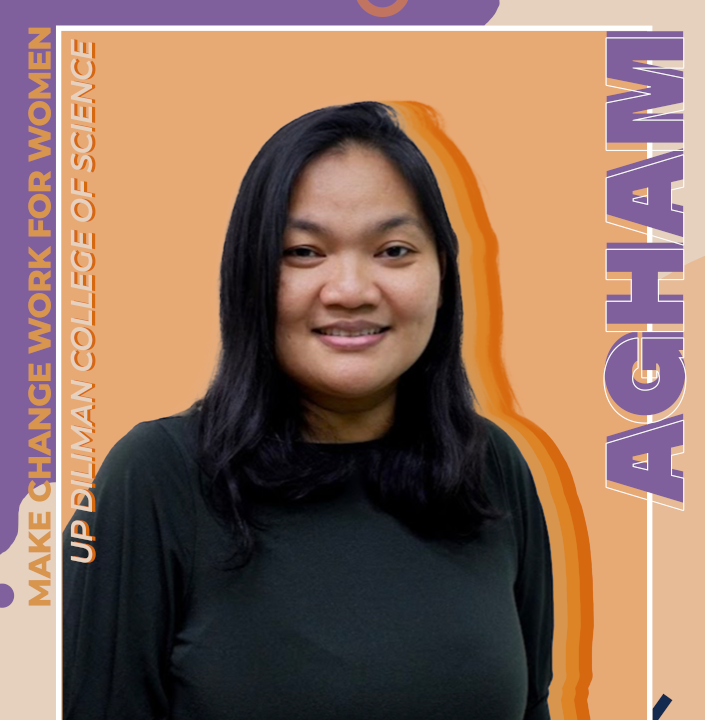
As a chemist, Dr. Monissa C. Paderes volunteered, together with her colleagues from the Institute of Chemistry (IChem), to help in their own ways through producing liters and liters of alcohol sanitizers that were in demand at that time. The Institute also formulated guidelines on the preparation of these alcohol sanitizers, following the protocols of the Food and Drug Administration. Through this, Dr. Paderes was able to realize anew her commitment to serving the country through her profession.
Dr. Paderes is an assistant professor at IChem and the principal investigator of the Organic Synthesis and Supramolecular Chemistry Laboratory (OSSCL), the laboratory she established just six months into IChem. OSSCL designs and synthesizes organic molecules and polymeric materials for various biological, and materials science applications. The laboratory’s research goals are in line with Dr. Paderes’ research interests which include synthetic organic chemistry, supramolecular chemistry and polymer chemistry.
Dr. Paderes obtained her master’s degree in chemistry at the University of South Carolina, Columbia and her doctorate degree in chemistry at University at Buffalo, The State University of New York. She then proceeded to do her postdoctoral fellowship at the National University of Singapore and then at KU Leuven and Procter & Gamble in Belgium.
In 2017, she went back to the Philippines and became a faculty member of the Institute of Chemistry. Dr. Paderes saw big improvements in the capabilities not just of IChem but of UP Diliman. “[Our country] still has a long way to go but compared to 20 years ago, we have improved a lot especially in the facilities and funding aspects, although I believe that we can still do better,” she shares. She also cites the UP Balik PhD and DOST Balik Scientists programs as commendable efforts to invite foreign-trained fellows back to the Philippines for good.
After four years as a faculty researcher and head of her laboratory, Dr. Paderes has found her home in IChem, specifically in her beloved OSSCL. The laboratory has secured numerous fundings over the years and has already hosted a number of undergraduate and graduate students as well. After her immediate local response to COVID-19 in 2020, Dr. Paderes and her lab are currently working on the design and synthesis of potential COVID-19 inhibitors. Their study specifically aims to identify SARS-CoV-2/ACE2 inhibitors via structural modifications of natural products commonly found in terrestrial plants. Another current endeavor is part of a drug discovery program and aims to chemically modify deguelin and rotenone to enhance anticancer activity and lower their toxicity. And in a collaborative project with UP Diliman College of Science Dean, Dr. Giovanni A. Tapang, they have also been investigating the synthesis and photodimerization of anthracene-containing polymeric materials and exploring their applications as functional materials.
“I believe the pandemic speaks of how we are perceived as researchers and scientists,” says Dr. Paderes. With the current limitations and challenges of doing research, she hopes that in the upcoming 2022 national elections, our country will elect more leaders who will support scientific and medical research and hopefully who will handle health crises rationally.
Dr. Paderes plans on pursuing her research endeavors here in the country and wants to continue her passion as a mentor and consultant. She has enjoyed her life as a teacher and hopes to be an inspiration to budding scientists. “Scholarships are widely available nowadays, so if they are truly passionate about science and in ‘discovering the unknown,’ they should take every opportunity they can find and pursue their scientific goals,” Dr. Paderes advises younger generations. She also hopes that they will use social media platforms more productively by taking advantage of free online workshops and webinars to expand their scientific vocabulary.
Dr. Paderes is a recipient of the 2021 UP Diliman Centennial Faculty Grant and the Dr. Barker H. Brown Professorial Chair. Despite the limitations set by the pandemic, she continues to share and apply her expertise, and guide her research assistants, masteral students and undergraduate students toward discovering the potential of OSSCL.
Beginning her fruitful scientific journey at the International Rice Research Institute (IRRI), Dr. Jessica D. Rey boasts of more than two decades’ experience as a rice researcher/scientist. Although she is now expanding her research endeavors to other plant species with medicinal value or high value crops such as lettuce, strawberry, tomato and pepper, she is grateful to her stepping stone for giving her a hopeful perspective in food security and research for humanitarian purposes which she carries with her as she continues her research.
Dr. Rey, commonly referred to as “Dr. J” by her colleagues and students, is a geneticist, molecular biologist and currently an assistant professor at the Institute of Biology, UP Diliman where she leads its Plant Molecular Phylogenetics Laboratory. She teaches courses on genetics, plant morphoanatomy, and developmental biology.
After completing her bachelor’s degree in biology at UP Los Banos, Dr. Rey taught science in the UP Rural High School for a year. She then pursued her master’s in genetics under a scholarship from the Department of Science and Technology and got the chance to do her MSc thesis in IRRI. During this period, she became aware of three things: (a) the global food security systems and situation, (b) that her passion is research, and (c) that she wanted to continue research as service to the country and the world. It was also through this opportunity that she developed and honed her abilities in bench science, and writing and presenting her research, which she considers as important factors in becoming a scientist.
Dr. Rey took her doctorate degree in genetics also in UPLB while still working at the IRRI. And as one would expect, she continued working at the world’s premier research organization after earning her PhD. She climbed from being a student researcher toward becoming one of their head scientists and project leaders.
As a petite female scientist in the 90s who took the chance to explore the previously male-dominated field, Dr. Rey’s mantra was, ‘stand your ground and assert what you can contribute and what you know.’ “Listening to a woman, especially from a molecular biology perspective, was difficult during that time,” she says. Despite setbacks she experienced as a woman in science, she worked hard to earn the respect of higher level scientists until she was noticed and seen as somebody who would bring something to the table.
Much like any other women, motherhood also became a challenge for a budding scientist like Dr. Rey. When she started a family, she wanted to be hands-on and be present as much as possible, but her work demands her to be active in field research. “I would miss out on activities in school and would really feel bad about it. It was hard, but I needed to sacrifice a bit of my motherhood for my career,” shares Dr. Rey. It was often hard to weigh these priorities but she was lucky to be in an understanding work environment where her role as a parent was given importance. Having successfully built her career and raised her family, she can’t help but hope for better treatment to fellow working mothers who may not have the privilege that she had. She lobbies for a supportive and enabling working environment for parents, especially mothers, who may feel that they have to give up on advancing their careers in order to build their families.
“I am almost satisfied with my career but I think I could influence more and do better,” Dr. Rey says. This is why apart from being a Biology teacher, mentor and scientist seeking national development through research, she also wants to campaign for accessible education for orphans, less fortunate children, victims of abuse and drug-dependent parents, and other vulnerable children. She hopes that education and other opportunities for them would become a government initiative because this is a way to lower the illiteracy rate of the country.
Additionally, Dr. Rey advocates for women leaders. Our country is evidently dominated by men in higher positions in the government so this election season, she hopes that people consider females, this time, to assume government leadership. “I have read and known many women who have the capability to lead some of our government agencies like DOST, DA, DENR, and DOH. I hope that in this coming election, we vote for new public servants who will reiterate that women can lead too.”
Dr. Rey and her co-proponents recently celebrated the success of the Smart Plant Production In Controlled Environment (SPICE), a project funded by DOST-PCIEERD aiming to establish a smart indoor farm for food production.
Dr. Rey is a licensed Agriculturist, a lifetime member of the Asia Rice Foundation and the Crop Science Society of the Philippines Inc, and an active member of the Society for the Advancement of Breeding Research for Asia and Oceania, and the Philippine Association of Agriculturists Inc.
Often called “Marianne” by her colleagues and “MAM B” by her students, Ma. Anita Mascarenas Bautista, Ph.D. is a professor at the National Institute of Molecular Biology and Biotechnology (NIMBB) in UP Diliman where she also heads the Functional Genomics Laboratory. She served as the Program Director of the DNA Sequencing Core Facility and the Agriculture, Livestock, Fisheries, Forestry in the Philippine Genome Center (PGC), a genomics research facility in UP.
Dr. Marianne’s science-directed education and career started during her bachelor’s degree in Agriculture in UP Los Baños, where she realized that the program does not solely revolve on farming but was a mixture of going out to the fields, doing laboratory experiments and doing research that are beneficial to farmers. These were all the things that piqued her interest and encouraged her to major in Entomology—a field that sparked her love for insects.
From 2003 to 2009, Dr. Marianne pursued her master’s and doctorate degrees in Applied Entomology in Nagoya University in Japan under the MONBUKAGAKUSHO (Japanese Government) scholarship. Her graduate dissertation was about the molecular biology of insecticide resistance to a particular crucifer pest. She did her postdoc in Ohio State University, USA where she explored omics technology, an area of study that involves the universal detection of genes, mRNA, proteins and metabolites in biological samples.
Her advanced studies in molecular biology and omics led to her recruitment as a faculty member of NIMBB in 2013. By then, PGC had just been inaugurated and Dr. Marianne was also assigned as the laboratory manager of its DNA sequencing facility which she also directed years later. Her current research interests include the molecular biology and biochemistry of insecticide resistance, genome sequencing and anything related to omics technology.
As she looks back to her journey toward being a successful woman scientist, Dr. Marianne recounts many times that sacrifices were crucial and challenges were inevitable. She had to endure being away from her family including her daughter and son to advance her scientific studies abroad and eventually open greater opportunities for herself locally. “I think it happens to a lot of women, that after they marry and start to build a family, careers will really be affected,” she says.
Even earlier than her education abroad, when she was starting a family and simultaneously a career in research, she often found herself feeling heavy when leaving her kids at home between 8 a.m. to 5 p.m. every single day. There were times when she received paycuts because she chose to take care of her children at home. This is why Dr. Marianne believes that this is the time to transition workplaces into being output-based rather than equating productivity to time in the office. “These kinds of struggles do not only happen to women in science, but also to women in other fields who are being restricted by traditional working conditions. Oftentimes, the number of hours spent in the office is not equivalent to the level of productivity.”
With this concern at hand, Dr. Marianne hopes that future leaders of the country will create laws that allow more flexibility for women, especially those who would like to start a family. “The three to four months of maternity leave is sometimes not enough. I hope we can create a more nurturing environment for these women and their families such as adopting work from home arrangements and flexible schedules,” she says.
Dr. Marianne believes that women should not be limited to roles of a mother and a wife, but rather let them aspire for career development. “Let’s not let our dreams remain as dreams but rather work on realizing them,” she says. We need to learn as a mom scientist, both the hard and soft skills because these are our tools that will benefit the country. We can try to emulate our renowned Filipino scientists who have these hard and soft skills.” she adds.
As a woman scientist, she says one her roles is to encourage young women and the youth in general to get involved in science. And to do this, she envisions participating in more extension programs that will create opportunities for them and provide awareness of the different scientific fields that they can choose. “Many high schoolers may not want to be involved in unfamiliar programs such as molecular biology or genomics because they know nothing about it. It is our job as scientists to bridge the gap of information.”
Many Filipino scientists, with their different fields and expertise, have been presented with many opportunities throughout their careers. Many have proven their skills and knowledge in countries that offer greater and more advanced technologies and capabilities. Although pursuing scientific careers abroad may be fulfilling for some, many are still heeding the call to serve their own countries and become instruments, themselves, for the country’s scientific advancement.
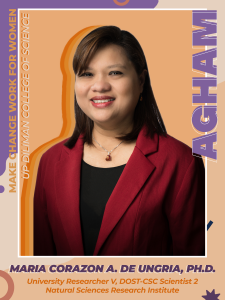
Microbiologist and forensic geneticist Maria Corazon “Cora” A. De Ungria, Ph.D. exemplified this patriotic gesture when she went home to the Philippines in 1998, armed with a doctorate degree in microbiology from the University of New South Wales and more than 10 years of training abroad.
Since her return, Dr. Cora has been the head of the DNA Analysis Laboratory of the Natural Sciences Research Institute in UP Diliman. Concurrently, she is the director of the Program on Biodiversity, Ethnicity, and Forensics of the Philippine Genome Center. She is the highest-ranking REPS in UPD who currently holds the sole University Researcher V position. In 2013, Dr. Cora was conferred a Scientist II rank by the Civil Service Commission (CSC) and the Department of Science and Technology in the Scientific Career System that both agencies maintain for full-time researchers serving in government institutions.
Dr. Cora reiterates the importance of opportunities and the right kind of support such as competitive salary and benefits in molding a capable scientist like her. “[These] allowed me to focus my mind and passion toward research and service. Working in an enabling environment allows career scientists to focus on generating knowledge through research and serving the community in the best way we can,” she says.
Her research endeavors lean on human genetic diversity and maximizing the use of DNA as a tool for human identification in criminal investigations. Generally, her work revolves around discovering how science can help in addressing societal concerns in the Philippines through forensic DNA technology. With this line of research, her laboratory has received recognitions such as the 2019 Outstanding Institution Award from National Research Council of the Philippines (NRCP) for its pioneering work in promoting the use of forensic DNA technology and in exploring the genetic diversity of Philippine communities, including those of indigenous cultural communities/indigenous peoples (ICCs/IPs).
A more notable result of Dr. Cora’s research was the implementation of the Rule on DNA Evidence that was promulgated by the Supreme Court in 2007 and is now being used by all trial courts in the whole country. Having spent almost 30 years in research work, she boasts a long list of achievements and recognition such as the Outstanding Woman Researcher in the Life Sciences (organized by the Third World Organization of Women Scientists and Elsevier in Kuala Lumpur, Malaysia) in 2009; a National Fellow of the L’Oreal – UNESCO Women in Science Program in 2011; the Most Outstanding Alumni (awarded by the Australian Embassy in the Philippines) in 2017; and one of two Filipinas featured in “Profiles of Women Scientists in Asia” (published by the Association of Academies and Societies of Sciences) in 2019. In 2017, she also received the Dangal ng Bayan award from the CSC for her exemplary service to the country while observing the “Code of Conduct and Ethical Standards for Public Officials and Employees” or RA 6713.
She also advocates for the effective communication of research findings to stakeholders in order to create more concrete results. “Being in UP enabled me to present my research findings in local and international conferences that have opened opportunities for diverse collaborations,” Dr. Cora adds. Sharing her research also gave her chances to contribute to discussions on national policies and to the drafting of national and institutional guidelines for research involving human samples as well as in legislating laws that may help promote genomics and forensics in the Philippines.
As a woman in science who has managed to bring herself to the top of her field, Dr. Cora hopes to inspire more young girls to pursue a career in science through her own life story. She reminds fellow women scientists to partner passion with purpose, to be determined and not to give up easily because every scientific journey has its own challenges. Many times, she reiterates the value of taking risks—‘suntok sa buwan’—which could either result in ‘pagbagsak sa lupa o pagyakap ng langit.’
She hopes that opportunities specially designed for women scientists to participate in scientific research should be made available. Particularly, she is hoping to see changes for women who have chosen to build a family and career at the same time. “Many female scientists find it challenging to return to active research after starting their families. Professional societies should strengthen their networks in order to facilitate different platforms for research collaborations. In recognising and crediting the contributions of female scientists during different periods of their careers, we will foster an enabling culture for women to continue pursuing rewarding careers in science.”
Dr. Cora believes that it is essential for the development of the Philippines as a scientifically and technologically savvy country. Future leaders should form data-driven policies and laws, and support science by providing financial security to government scientists and funding for research. More importantly, Dr. Cora believes that leadership is best done by example. According to her, “A leader should be able to inspire others to be their own catalysts for change.”
#womeninSTEM #BreakTheBias
To know more about Dr. Cora A. De Ungria, you may visit and read her story in “Profiles of Women Scientists in Asia” through this link:

 The country has come a long way since the first recorded case of COVID-19 in the early months of 2020. Looking back to the first surge, many local departments—alongside health sectors—have adopted ways to mitigate and manage the pandemic. Big or small, these efforts greatly contributed to the overall improvement of our national COVID situation.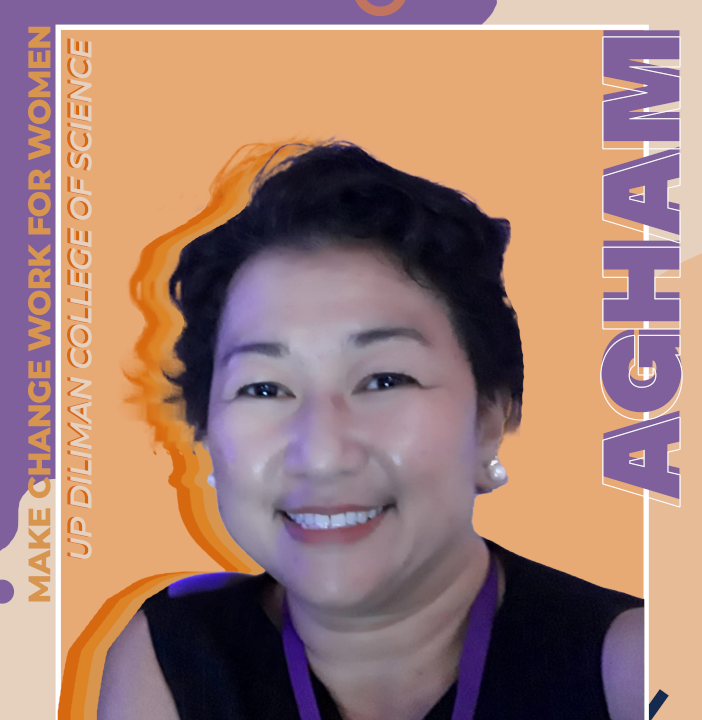
 Beginning her fruitful scientific journey at the International Rice Research Institute (IRRI), Dr. Jessica D. Rey boasts of more than two decades’ experience as a rice researcher/scientist. Although she is now expanding her research endeavors to other plant species with medicinal value or high value crops such as lettuce, strawberry, tomato and pepper, she is grateful to her stepping stone for giving her a hopeful perspective in food security and research for humanitarian purposes which she carries with her as she continues her research.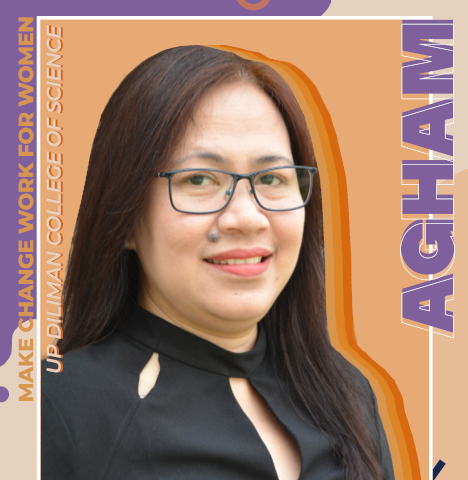
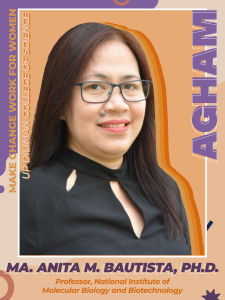 Often called “Marianne” by her colleagues and “MAM B” by her students, Ma. Anita Mascarenas Bautista, Ph.D. is a professor at the National Institute of Molecular Biology and Biotechnology (NIMBB) in UP Diliman where she also heads the Functional Genomics Laboratory. She served as the Program Director of the DNA Sequencing Core Facility and the Agriculture, Livestock, Fisheries, Forestry in the Philippine Genome Center (PGC), a genomics research facility in UP.
 Many Filipino scientists, with their different fields and expertise, have been presented with many opportunities throughout their careers. Many have proven their skills and knowledge in countries that offer greater and more advanced technologies and capabilities. Although pursuing scientific careers abroad may be fulfilling for some, many are still heeding the call to serve their own countries and become instruments, themselves, for the country’s scientific advancement.