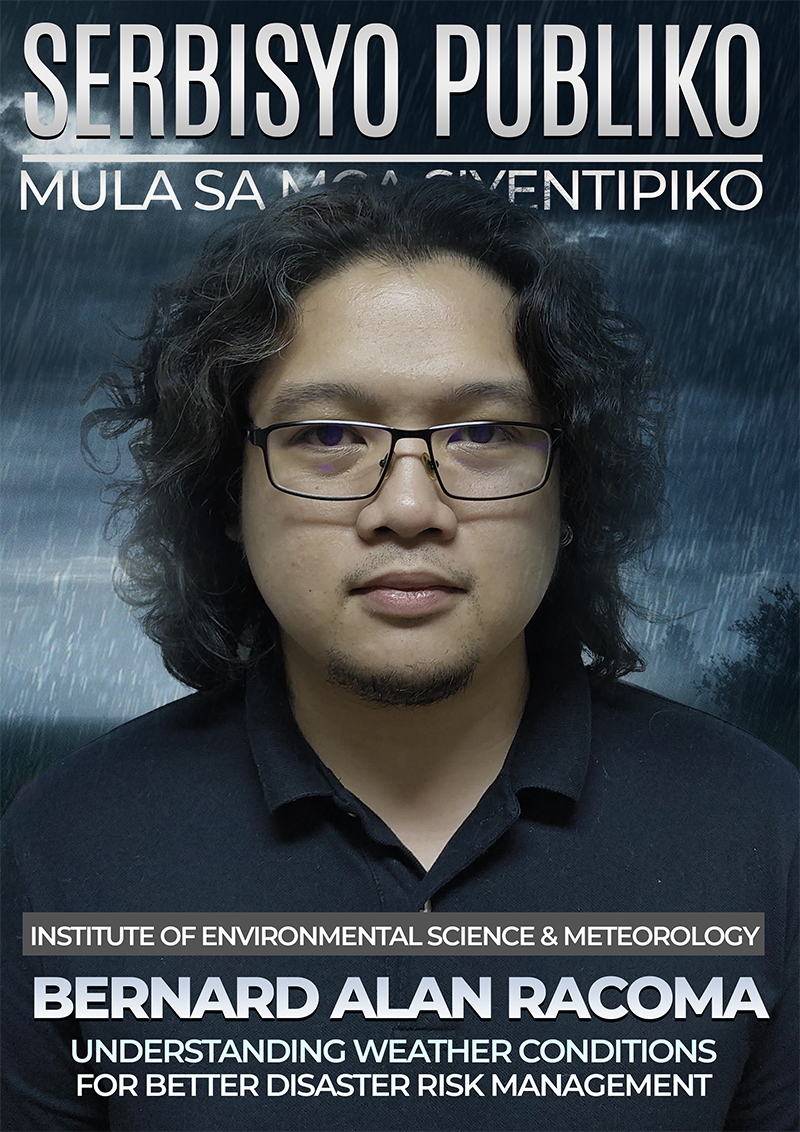
 Bernard Alan “BA” Racoma is currently a 3rd year PHD student and an instructor in the Institute of Environmental Science and Meteorology (IESM). Through a scholarship, he is taking up a double degree: a PHD in Meteorology at the University of the Philippines Diliman and a PHD in Atmosphere, Oceans and Climate at the University of Reading in the UK.
Before his doctorate studies, he also ventured into the world of Applied Physics as an undergraduate and Geology as an MS student. That being mentioned, BA has studied and is currently studying multiple disciplines and calls himself a hybrid scientist. “It allows me to see multiple, holistic perspectives. It also lets me understand how one field affects the other and, more importantly, how these scientific fields relate to social studies and humanities,” he says.
 In 2011, BA was recruited as part of the ClimateX project where he helped in developing a tool to convert satellite data into meaningful information that will predict rainfall. The tool is helpful in monitoring rainfall during extreme weather events like tropical cyclones and enhanced monsoons. In 2016, he joined DOST’s Project Nationwide Operational Assessment of Hazards or Project NOAH. Project NOAH is a response program that monitors satellite or radar data used for real time risk assessment. Through this, they were able to provide the list and maps of high-risk areas that were used by different agencies to respond and manage the typhoon. These projects were carried on to monitor other succeeding weather events. As an IT Officer of NOAH, he led the IT and web development team before he moved on to take further studies in 2018.
 BA wants to relay the importance of science communicators. Although he believes that people generally have more awareness of the weather, atmospheric and climate status because of the use of different social media platforms, he still thinks that there is a need to bridge the gap that sets apart the scientific community and the society. “A scientist’s mission should not only be to publish a paper, but also to be able to relay their research to the public through effectively translating its findings and implications.”
BA hopes to inspire more Filipino scientists in the future as he plans to continue teaching in IESM after he finishes his PHD. He is greatly knowledgeable in Geographic Information System (GIS) Mapping and Programming and this is one of the skills that he wants future environmental scientists and meteorologists to learn. He wants to relay the importance of good mentorship to people who are still creating the person they want to be. Some students that he used to mentor in the past have become engineers, doctors or taking up higher studies, and he feels fulfillment in this. “Although I did not directly help them in becoming professionals, I’d like to think that I somehow inspired them,” he adds.
“In whatever science you are studying, besides asking all questions you need to understand, try to look at what you’re studying from different perspectives and always think how your science can be of benefit to people,” says BA to those who want to pursue higher studies and research.
For weather updates and important information, you may follow BA on twitter: @bumaBAgyo
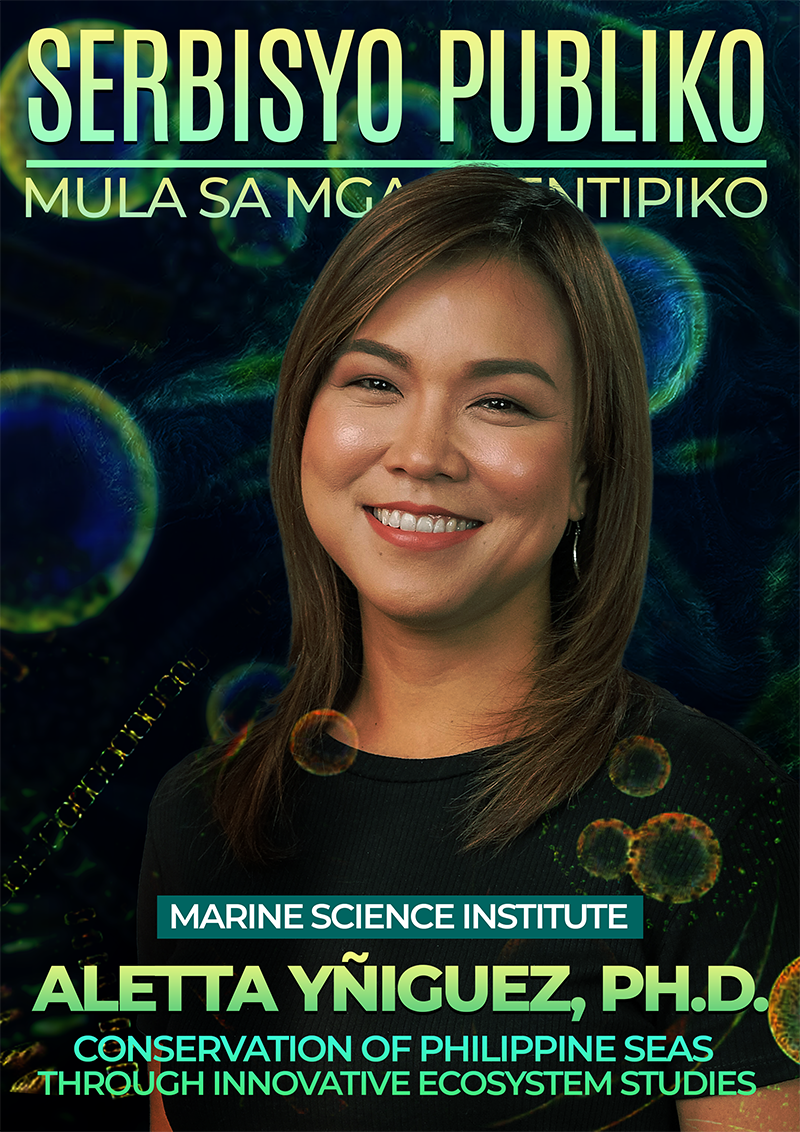
 As a faculty member and scientist in the Marine Science Institute (MSI), Dr. Aletta Yñiguez’ area of interest includes marine ecology, biological oceanography, ecological modelling, and dynamics of marine systems. Currently, she is still focusing on these specializations but with a distinct objective—to develop tools model for sustainable fisheries that will be accessible not only to big industries but also to small-scale fisherfolks.
 It is her ultimate goal to generate scientific information, tools and systems that help ensure the health of our ocean resources; this includes developing decision-support systems for resource managers like BFAR, DENR, as well as coastal communities. Particularly, these tools and systems provide real-time ocean status. This data and information are then used to forecast probable change in the conditions of the water that may help decision-makers like LGUs determine the best course of response to take. This will greatly help the public as most sea-related issues generally affect them, taking red tide as an example.
 Dr. Yñiguez is also involved in extension programs such as organizing summer camps and marine science events for the youth because she believes that producing advocates of science starts at the basic level of education and that there is a need to strongly enhance scientific literacy in the country.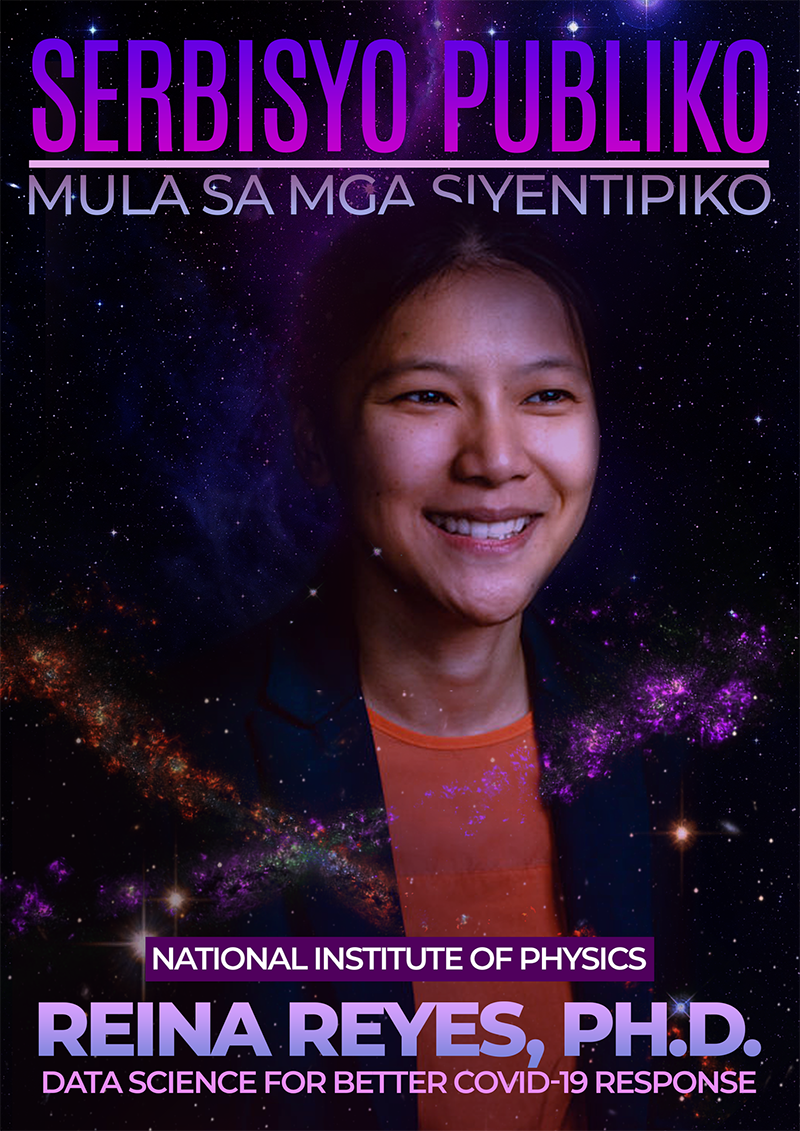
 It was in 2014 when Dr. Reinabelle Reyes decided to go back home to the Philippines and eventually settle. At the height of her scientific career abroad, with her confirming Einstein’s theory of relativity and making headlines for her scientific discoveries and achievements, she questioned herself,
 Currently, Reyes is working with the United Nations Development Program (UNDP), in the laboratory called “Pintig Lab,” to apply data science and analytics to developmental problems. As the lab’s chief technical adviser, she supports and guides the lab’s initiatives to monitor and track the COVID-19 pandemic and provide data-driven support to DOH, IATF, and other agencies in their response and recovery efforts. “The [COVID-19] pandemic showed the importance of timely and accurate data and the need to invest in people who have the skills and mindset to collect, organize, analyze and present data to decision makers,” says Reyes whose current goal is to contribute to helping PH achieve the sustainable development goals.
 She also used to travel to deliver talks around the country which was recently diverted into online talks with today’s current challenges. While still sharing topics on astrophysics, Reyes is more dedicated to sharing her experience and knowledge on data science, hoping to spread its importance to many societal aspects and of course, to inspire younger generations.
 In UP, Reyes is also helping undergraduate and graduate students in addressing societal challenges by way of research. She believes that faster solutions can be done through accurate and thorough research. Through being a teacher, she hopes to nurture Pinoy scientists who will have the heart to do scientific research for the betterment of the country. She is currently an Associate Professor at the National Institute of Physics and heads the Data & Computation Research Group under the Theoretical Physics Group. The group’s research interests currently fall under topics in data-driven astronomy— including gravitational wave astronomy and extragalactic astrophysics— and computational physics and data analysis— including machine learning and data for social good.
 “With the connectedness of the world, it is easy for the youth to gain new knowledge everyday. Use the resources we have today to satisfy your curious minds.” These are her words of wisdom to the youth. She wants to encourage scientists of today to support the next generation of scientists so that the country becomes a better place for learning and doing science.