
UP Scientists Apply Green Method to Produce Silver Nanoparticles for Antibacterial Applications
Published: February 3, 2026
By: Eunice Jean C. Patron
Scientists from the University of the Philippines–Diliman College of Science (UPD-CS) have advanced a greener approach to silver nanoparticle (AgNP) synthesis by using gamma irradiation in combination with the natural seaweed-derived biopolymer ι-carrageenan. While gamma-radiolytic routes for AgNP formation have been reported previously, the specific role of ι-carrageenan in stabilizing and influencing nanoparticle formation during radiolysis has remained largely underexplored.
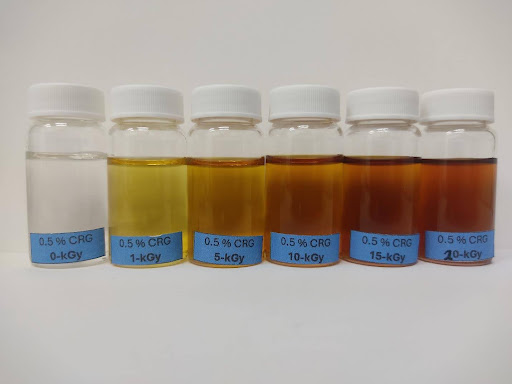
Instead of using harsh chemicals, researchers Mon Bryan Gili, Wendell Manuel, and Dr. Marienette Vega of the UPD-CS Materials Science and Engineering Program (MSEP); Dr. Marlon Conato of the UPD-CS Institute of Chemistry (IC); and Rakshith Gowda Shankaregowda and Dr. Manh-Huong Phan of the University of South Florida used gamma radiation and a natural seaweed-derived substance called carrageenan to create the nanoparticles.
“In simple terms, we let radiation do the “work” of forming the particles, while the seaweed extract keeps them stable and safe. We then tested how effective these particles are against common bacteria,” Gili explained. Compared to traditional chemical methods, the researchers’ approach is much greener.
Chemical synthesis often requires strong reducing agents and stabilizers, which can be toxic and difficult to dispose of safely. In their method, gamma radiation completely replaces these chemicals. It also sterilizes the nanoparticles as they form, which is a major advantage for medical applications. “Overall, this means fewer processing steps, less chemical waste, and a safer product for both people and the environment,” Gili added.
As a researcher in nuclear science, Gili was excited to apply radiation technology in a way that directly benefits health and sustainability. Concern for environmental safety and the growing issue of antibiotic resistance motivated him and his team to explore alternative methods for producing silver nanoparticles. Many conventional approaches use toxic chemicals that can harm people and the environment.
“The next steps include improving their long-term stability, testing them in real-world products, and evaluating their safety for human use.” Gili said. “Ultimately, we hope this technology can lead to affordable, locally produced antibacterial materials using Philippine natural resources and nuclear science expertise.”
Their paper, “Antibacterial evaluation of radiolytically synthesized silver nanoparticles with ι-carrageenan stabilizers,” was published in Radiation Physics and Chemistry, a journal featuring studies which focus on research and developments involving ionizing radiation in radiation physics, radiation chemistry, and radiation processing.
References:
Gili, M. B., Manuel, W. A., Guillermo, N. R., Shankaregowda, R. G., Phan, M., Conato, M. T., & Vega, M. M. (2025). Antibacterial evaluation of radiolytically synthesized silver nanoparticles with ι-carrageenan stabilizers. Radiation Physics and Chemistry, 236, 112941. https://doi.org/10.1016/j.radphyschem.2025.112941
For interview requests and other concerns, please contact media@science.upd.edu.ph.