SCIENCE – University of the Philippines Diliman
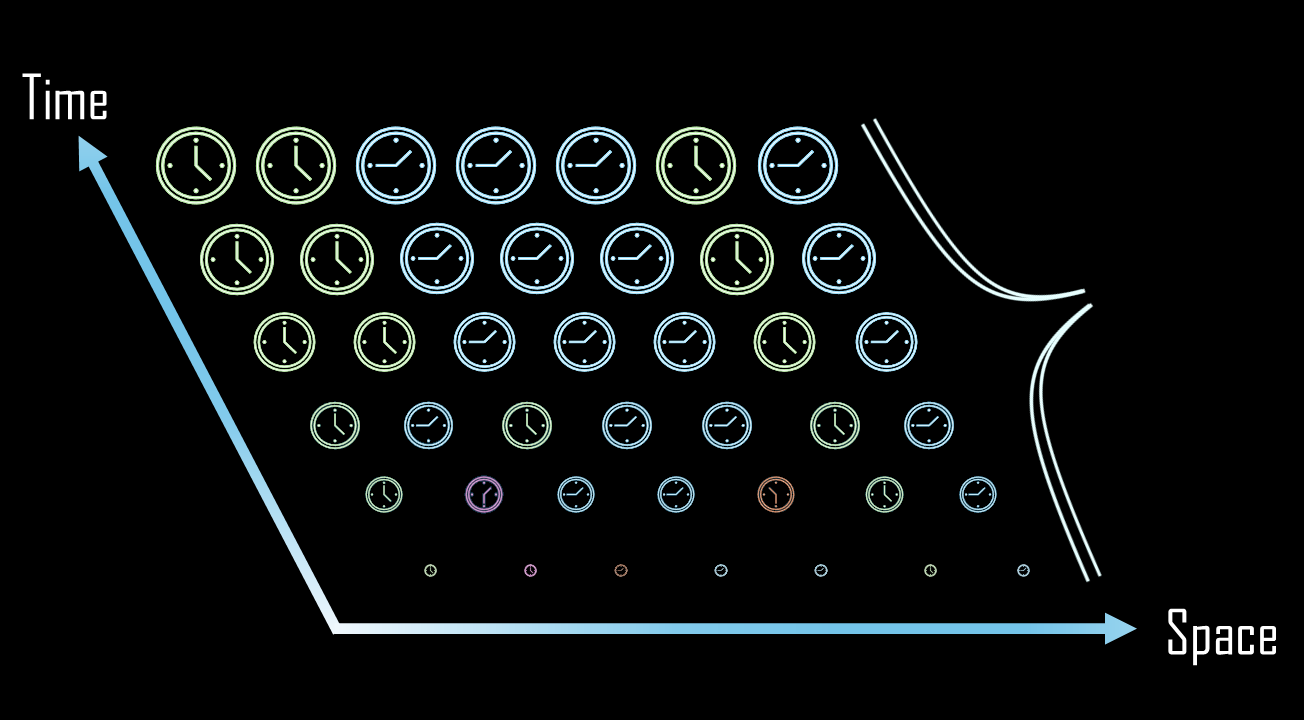
A time crystal is a phase of matter, much like solids, liquids, or gases—but with a remarkable difference. Instead of remaining static, it exhibits a steady and predictable rhythm. Just as a solid is defined by the arrangement of its atoms in space, a time crystal is defined by a repeating pattern in its behavior over time.
The concept of time crystals as a phase of matter is relatively new, and much remains to be understood—particularly how they form and whether their formation follows simple, universal rules similar to those observed in other systems.
Roy Jara Jr. and Dr. Jayson Cosme of the University of the Philippines – Diliman College of Science’s National Institute of Physics (UPD-CS NIP) showed that universality—a concept in which very different systems can share the same underlying physics when collective behavior emerges—also applies to time crystals.
“We showed that the formation of a time crystal follows a universal rule similar to other simpler systems, such as a network of interconnected pendulums,” Dr. Cosme shared. “This universal rule includes how fast time crystals form and the number of defects or imperfections that may arise.”
The time crystal studied in their work emerges from the interplay between interactions among the constituent particles (where each particle interacts with many others) and the fact that part of the system also interacts with its environment—a process known as dissipation. This is similar to air molecules escaping from a balloon.
The physicists demonstrated universality in time crystals using the Kibble-Zurek mechanism, a theoretical framework that has been successfully used to predict how many defects form in a system undergoing a phase transition. “Defects in this case are ‘imperfections’ and the Kibble-Zurek mechanism predicts that the faster you force a system to change, by varying a parameter like temperature, the more defects you will create,” Dr. Cosme said.
A useful analogy can be found in blacksmithing. When red-hot steel is rapidly cooled in water, internal stresses and misaligned crystal structures can become trapped in the material. These are ‘defects’ that make the steel more brittle. Blacksmiths carefully control the cooling process—often repeating heating and quenching cycles—to reduce such defects and improve the metal’s strength.
In their work, the physicists showed that two different models—one classical (a network of interconnected pendulums) and one quantum (a network of quantum spins interacting with light)—exhibit the same behavior when time crystals form. Both the delay in the formation of time crystals and the number of defects that form follow the same laws and depend in the same way on the speed at which the system is driven toward forming a time crystal.
Their results have important implications for how time crystals may be prepared in future technologies. There is significant interest in using time crystals for quantum information and sensing; however, these applications require the reliable and controlled preparation of the time crystal itself.
“We predict that time crystals can not be prepared arbitrarily fast due to an inherent delay in their formation, especially close to the transition point at which they emerge. Also, if one aims to scale this up into a network of time crystals, extreme care must be taken regarding the speed of creation. Because these systems are subject to the Kibble-Zurek mechanism, we have shown that pushing the transition too quickly will inevitably lead to the formation of unwanted defects, which could compromise the stability and utility of the entire network,” Dr. Cosme said.
The study, “Universality of dissipative discrete time crystal formation,” is published in Physical Review B, a trusted journal for significant developments in condensed matter and materials physics.
References:
Jara, R. D., & Cosme, J. G. (2026). Universality of dissipative discrete time crystal formation. Physical Review B. https://doi.org/10.1103/jjqm-f8hm
For interview requests and other concerns, please contact media@science.upd.edu.ph.