UP Chemist Co-Develops First Filipino Air Monitor
Published: July 23, 2026
By: Eunice Jean C. Patron
The World Health Organization (WHO) emphasized this year that air quality monitoring is crucial for understanding the health effects of air pollution and tracking efforts in reducing it.
Combining scientific inquiry and engineering in air quality research, Dr. Len Herald Lim of the University of the Philippines – Diliman College of Science’s Institute of Chemistry (UPD-CS IC) co-developed the Robust Optical Aerosol Monitor (ROAM)—the first Filipino-made air quality monitoring device—in 2014.
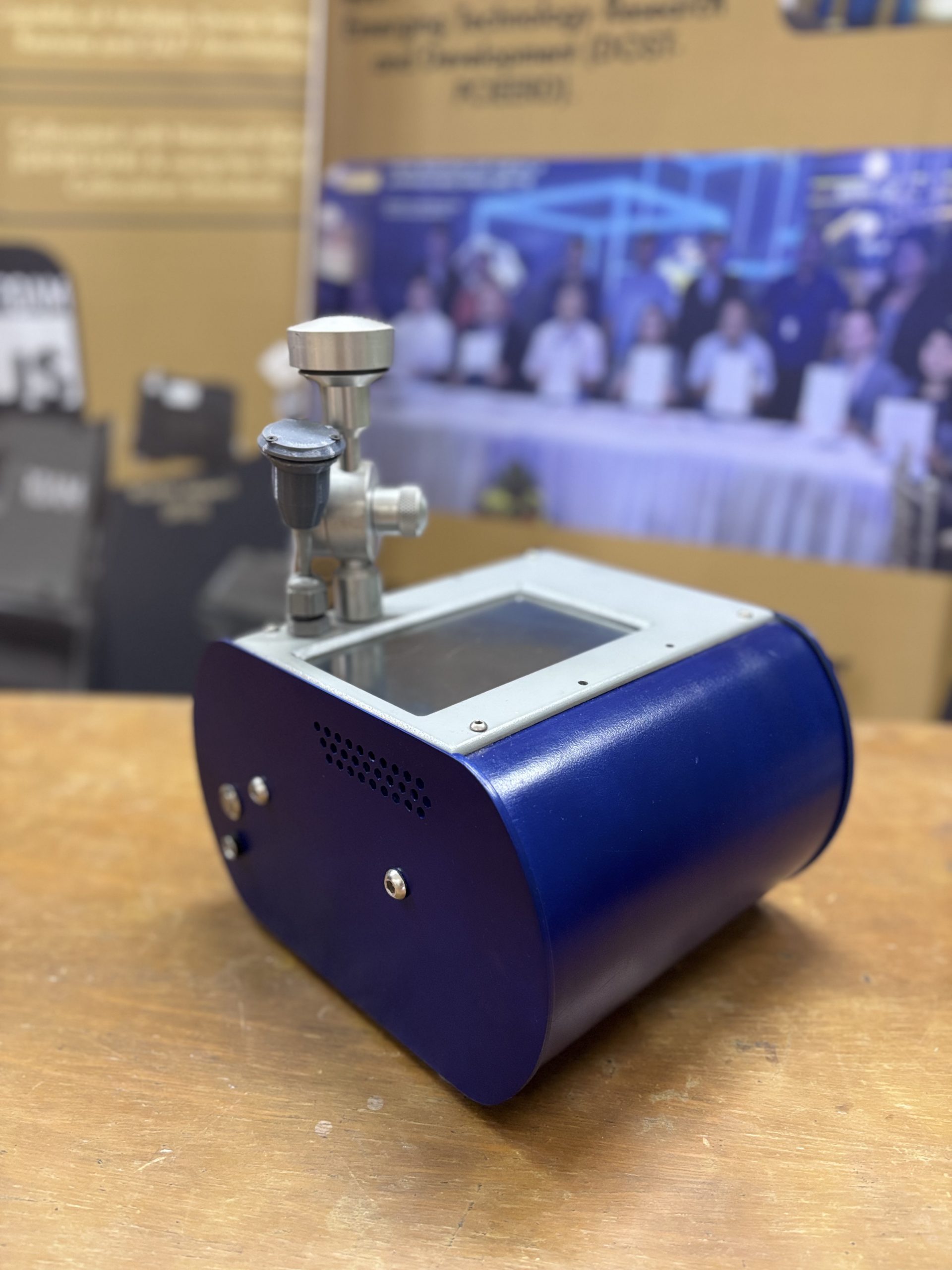
ROAM’s performance is comparable to contemporary aerosol monitoring devices used in industry and by the Department of Environment and Natural Resources – Environmental Management Bureau (DENR-EMB). Dr. Lim collaborated with Engr. Paul Alexander Darvin of UP Los Baños – Department of Electrical Engineering on this project, which started as a simple air quality measurement idea and evolved into an innovation.
“In a sense, ROAM is an air microscope. If you’ve experienced microscopy before, like cell counting under a microscope, this is very similar. The difference is that instead of cells, what we are counting are particles in the air,” Dr. Lim shared during the sixth Innovation Impact Stories webinar of the UPD-CS Innovation Program. He also noted that the equipment and the device setup are not dependent on machining very small parts.
Project ROAM’s first real long-term deployment was in Cauayan, Isabela. “The unit stayed there for about six to eight months. There wasn’t anything particularly dramatic about it, except that it was placed in a dusty environment,” he said. He further explained that the air quality monitor used by the DENR-EMB cannot just be placed anywhere, especially in very polluted environments, because after some time it would need maintenance or repair.
When the unit was returned, it was initially assumed to be damaged; however, upon inspection, it was found to still be functional.
“It was impressive because I really expected it to be completely clogged. The outside of the unit was so dirty, but it was still working. That’s because it doesn’t rely on a pinhole—it functions like a microscope,” Dr. Lim remarked. “And since it works like a microscope, its saturation limit is much higher than normal air monitoring equipment.”
Aside from Isabela, their farthest deployment was in South Cotabato, where the unit remained functional after being left unattended in the area for nearly six months. Repairs for ROAM were also inexpensive, which made it difficult for people to believe it was high-quality equipment.
“Right now, we’ve found that the best adopters of this technology are local government units (LGUs). That was actually how we positioned and advanced Project ROAM. People started coming to us—we didn’t even know who referred them,” Dr. Lim concluded.
Innovation Impact Stories is a webinar series that explores how science, technology, and innovation drive real-world impact. This initiative highlights the journeys, challenges, and successes behind research-driven innovations that have made meaningful contributions across various fields. It aims to inform and inspire students, researchers, and faculty to foster a culture of purposeful and collaborative innovation that bridges academic theory with practical application.
For inquiries about Innovation Impact Stories, please message cs.innovation_committee@science.upd.edu.ph
References:
Air quality monitoring for enhanced understanding of health impacts and beyond. (2026, February 20). World Health Organization (WHO). https://www.who.int/publications/i/item/B09646#:~:text=Overview,and%20Policy%20Summaries%20(SPS)
For interview requests and other concerns, please contact media@science.upd.edu.ph.