
New Study Finds Alarmingly Low Genetic Diversity in Philippine Eagle
Published: June 26, 2026
By: Eunice Jean C. Patron
The Philippine eagle, the country’s national bird, is one of the largest and most powerful eagles in the world. Susceptible to habitat destruction and fragmentation, it is currently listed as Critically Endangered by the International Union for Conservation of Nature, making it one of the most threatened birds globally. To help ensure its survival, scientists have carried out a captive breeding program in protected facilities for over 30 years as part of conservation efforts.
Dr. Cynthia Saloma of the University of the Philippines – Diliman College of Science’s National Institute of Molecular Biology and Biotechnology (UPD-CS NIMBB) led a team composed of Dhan Mikhail Perdon, Franchesca Pascual, Francis Tablizo, Carlo Lapid, John Michael Egana, Renato Jacinto Mantaring, Kris Punayan, Shiela Mae Araiza, Jo-Hannah Llames, and Ma. Celeste Abad of the Philippine Genome Center; Dr. Juan Carlos Gonzalez of UP Los Baños; and Dr. Jayson Ibañez of the Philippine Eagle Foundation (PEF) to study the DNA of 35 Philippine eagles under the care of PEF.
The team aimed to create a draft genome of the Philippine eagle to help guide conservation efforts. Through collaboration with PEF, they sequenced the DNA of Philippine eagles under their care in Davao City. “A genome is a living organism’s complete set of genes,” the scientists explained. “From the extracted DNA sequences, we were able to assemble a representative genome for the species.”
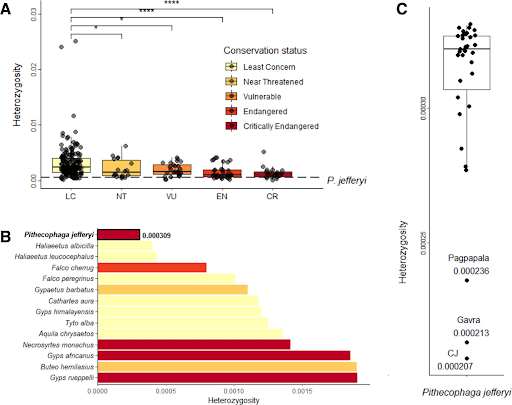
Their study reported a novel finding that the Philippine eagle has exceptionally low genetic diversity, meaning individuals are highly similar to one another and share nearly the same set of genes. “The danger is that when there’s little variation, the species struggles to adapt to changes. For example, if a new disease appears or the environment shifts, most eagles would react the same way and have the same capacity to adapt—and if they’re vulnerable, the whole population could be wiped out,” they said.
The team noted that this also increases the risks associated with inbreeding, which occurs when eagles are forced to mate with closely related individuals due to small population size and fragmented habitats. In such cases, harmful traits or genetic weaknesses are more likely to appear in offspring. Over time, this can result in reduced fertility, weakened immune systems, and physical abnormalities that make survival more difficult. “In short, low genetic diversity makes the Philippine Eagle fragile and more likely to face extinction when challenges arise,” they added.
Their findings also suggest that the Philippine eagle population was already declining before widespread deforestation. One possible explanation is that long-term ecological changes—such as the loss of connected habitats when sea levels rose thousands of years ago, fragmenting what were once larger continuous landmasses in Mindanao—may have disrupted population stability and isolated eagle groups. It is also possible that early human activities in the Philippines, such as hunting or competition for prey, placed additional pressure on the population.
The scientists clarified that these are hypotheses rather than certainties, but they help explain why the Philippine eagle decline appears to have started earlier than deforestation, which is often considered the main threat.
“By applying a genomics-driven, genetically informed approach, our study offers a blueprint for safeguarding other threatened species across the archipelago, and demonstrates how modern DNA analysis and bioinformatics can be leveraged to strengthen biodiversity management,” they said.
The study, “Genomic analysis reveals recent population decline and exceptionally low genome-wide heterozygosity of the critically endangered Philippine eagle, Pithecophaga jefferyi (Aves: Accipitridae),” is published in BMC Genomics, an open access, peer-reviewed journal that considers articles on all aspects of genetics, genomics, and proteomics.
References:
Perdon, D. M., Pascual, F., Tablizo, F., Lapid, C., Egana, J. M., Mantaring, R. J., Punayan, K., Araiza, S. M., Llames, J., Abad, M. C., Gonzalez, J. C., Ibañez, J., & Saloma, C. P. (2025). Genomic analysis reveals recent population decline and exceptionally low genome-wide heterozygosity of the critically endangered Philippine eagle, Pithecophaga jefferyi (Aves: Accipitridae). https://doi.org/10.1101/2025.10.27.684716
For interview requests and other concerns, please contact media@science.upd.edu.ph.