
UPD Chemists Create AI Tool to Predict Antibacterial Peptides
Published: May 12, 2026
By: Eunice Jean C. Patron
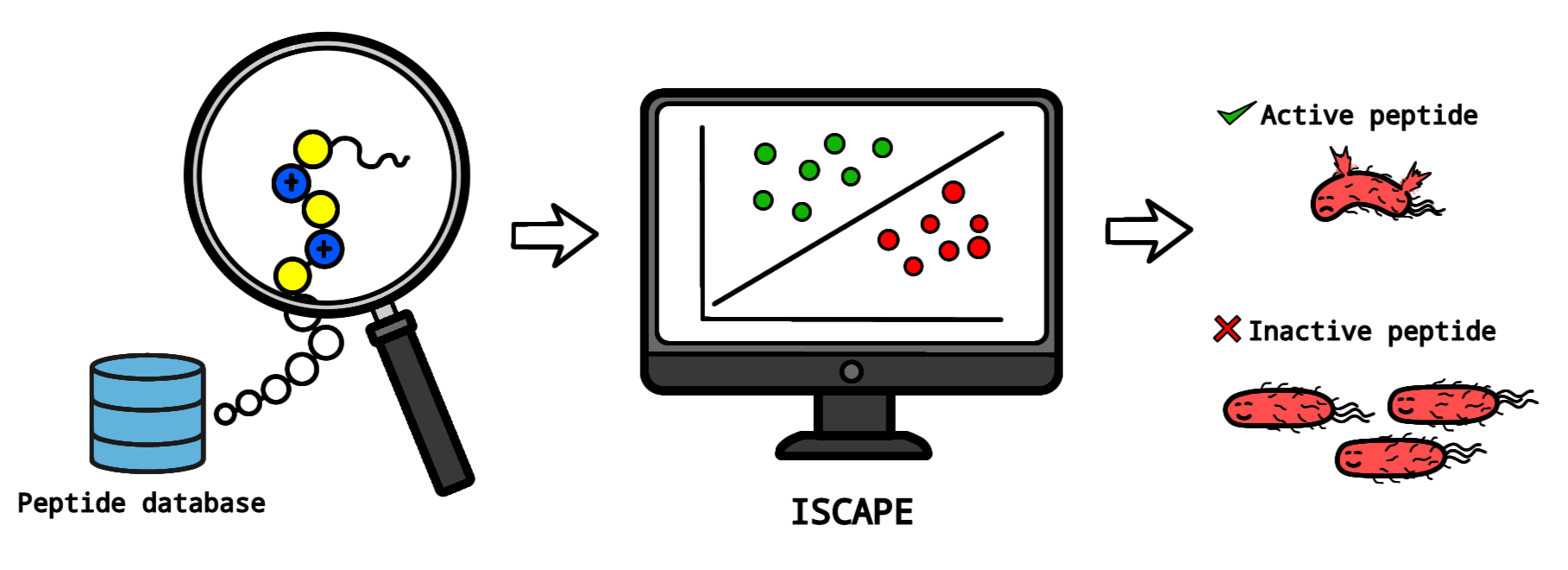
As antimicrobial resistance (AMR) continues to make traditional antibiotics less effective worldwide, the search for new antibacterial treatments has become increasingly urgent. One promising solution is antimicrobial peptides (AMPs), small molecules that can kill bacteria. To help accelerate their discovery, researchers at the University of the Philippines Diliman – College of Science (UPD-CS) have developed an AI tool designed to accelerate the discovery of new antibacterial peptides.
Remmer Salas, Dr. Portia Mahal Sabido, and Dr. Ricky Nellas of the UPD-CS Institute of Chemistry (IC) developed ISCAPE (Interpretable Support Vector Classifier of Antibacterial Activity of Peptides against Escherichia coli). It is an AI-powered tool that helps experimentalists predict whether a peptide can kill or inhibit the growth of E. coli. The system requires only a Simplified Molecular-Input Line-Entry System (SMILES) string as input, making it simple for researchers to evaluate candidate molecules.
“Traditionally, discovering antibacterial peptides means synthesizing many candidates and testing them one by one. This process is time-consuming,” said Salas. “We used AI to learn from existing data and identify patterns that distinguish active peptides from inactive ones.”
Unlike many AI tools, ISCAPE also shows which molecular features make a peptide effective. He noted that this helps researchers save time and resources. It reduces trial-and-error experiments and allows them to design better peptides more efficiently.
“ISCAPE helps address antimicrobial resistance by accelerating early-stage screening through data-driven peptide design,” Salas further explained. “It doesn’t replace laboratory experiments, but it makes discovery more efficient and helps researchers focus on the most promising candidates.”
The AI-powered model can be adapted to predict activity against bacteria other than E. coli. However, it would need to be retrained using high-quality datasets specific to the bacterial strains of interest. The ISCAPE approach could also be applied to predict the activity of other bioactive peptides.
“Applying ISCAPE to other biological targets requires well-curated datasets with experimentally validated activity,” Salas added. “The model must then be retrained using the molecular features we identified as optimal for peptides.”
The team hopes the tool will help researchers design better antibacterial peptides more efficiently and contribute to the global fight against AMR.
ISCAPE is publicly available for other scientists. The web server can be accessed through Hugging Face Spaces. The training data and code for large-scale prediction are available on GitHub.
The chemists’ research paper, titled “Interpretable support vector classifier for reliable prediction of antibacterial activity of modified peptides against Escherichia coli,” was included in the Journal of Molecular Graphics and Modelling. This international publication features papers on the use of computers in theoretical investigations of molecular structure, function, interaction, and design. It covers all aspects of molecular modeling and computational chemistry.
References:
Salas, R. L., Sabido, P. M., & Nellas, R. B. (2026). Interpretable support vector classifier for reliable prediction of antibacterial activity of modified peptides against Escherichia coli. Journal of Molecular Graphics and Modelling, 142, 109188. https://doi.org/10.1016/j.jmgm.2025.109188
For interview requests and other concerns, please contact media@science.upd.edu.ph.